Propaganda Then and Now: How Public Relations Shapes What We Believe
Introduction: From War Posters to Social Media Feeds
The Rachael Kay Albers’ podcast on marketing and propaganda really shows the impact that public relations has always had on the public. From World War I posters to today’s social media campaigns, propaganda has remained the same in one way. It has always been based on emotion. The government used fear and patriotism to influence citizens during World War I, and today it is being used in every social media campaign.
The tools used have changed, but the objective has remained the same. The objective has always been to influence people in a quick and effective manner even if it means compromising the truth. Today, the question that every public relations professional must ask themselves is: Where is the line between persuasion and manipulation?
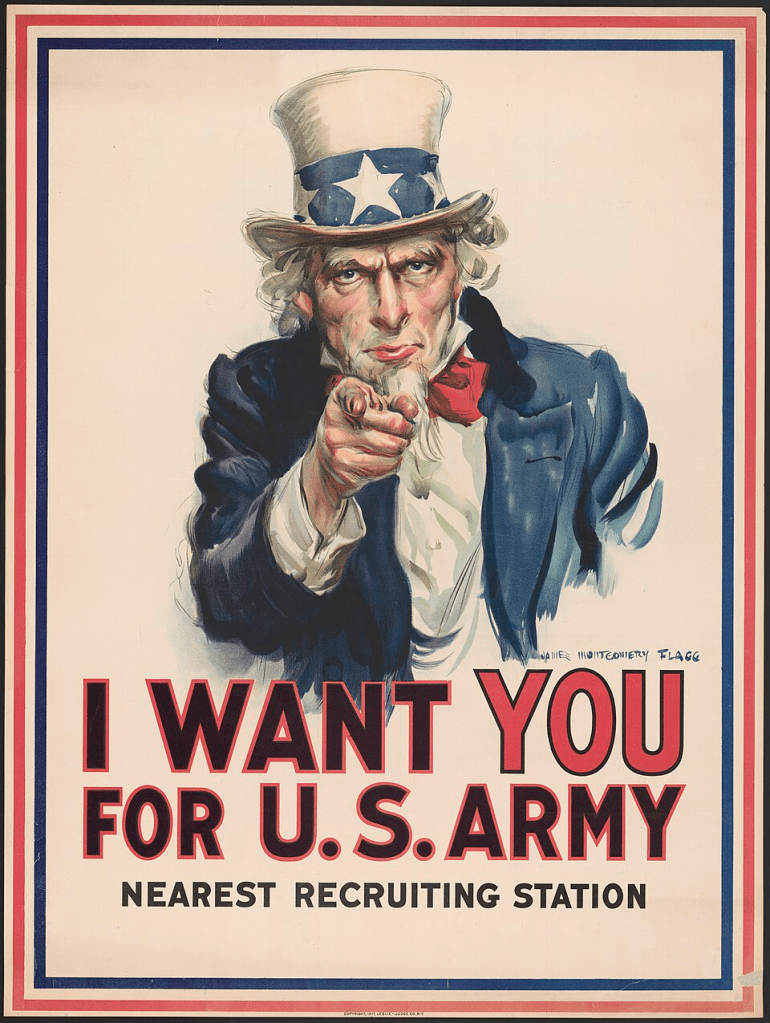
“I Want You for U.S. Army” poster, 1917. Courtesy of the Library of Congress, Public Domain.
Source: Library of Congress (Public Domain)
Emotional Appeals and the Power of Influence
One of the most dividing forms of propaganda that was discussed in the podcasts was the use of emotional appeal rather than actual information. Instead of showing different views on a subject, propaganda is designed to cause a strong reaction such as fear, anger, or pride.
For instance, during political elections, the propaganda may focus more on how the audience feels rather than what the audience knows. Research shows that emotions play a significant role in shaping attitudes and decision-making (American Psychological Association).
This technique is effective in the sense that it reduces complex problems to simple emotional responses, making it easy to convince many people in a short time.
Social Media and the Rise of Modern Propaganda
Social media is one of the most powerful ways to spread propaganda in today’s world. Unlike other forms of media, where there is proper filtration and examinations, social media like Instagram, TikTok, and X enable the distribution of information instantly.
According to the Pew Research Center, many Americans feel that the commonness of misinformation online causes confusion when it comes to basic facts. This is a clear sign of how easily public propaganda can affect personal opinions.
Another major concern is confirmation bias, where people are exposed to information that only confirms their pre-existing beliefs.
Ethical Challenges for Public Relations Professionals
The continued use of propaganda techniques presents a great ethical concern to PR professionals. Persuasion is a key part of PR, but this must be done in an honest and responsible way.
The Public Relations Society of America Code of Ethics states accuracy, truthfulness, and fairness in communication are essential to the practice of public relations. This is especially necessary in a time where misinformation is so easily spread.
PR professionals must ask themselves:
- Are we informing or manipulating?
- Are we building trust or simply gaining attention?
- Are we thinking about long-term credibility or short-term success?
These are important questions to be asked in order to uphold ethical standards in the field of PR.
Why This Still Matters Today
The evolution of propaganda proves that even as technology advances, responsibility remains a constant. PR has the power to educate, unite, and motivate. However, PR also has the power to deceive if not used appropriately.
For those looking to enter the PR industry, propaganda is not just about learning from past failures but about making better choices today. Ethical communication is key to building trust, and trust has never been more valuable than today.
References
American Psychological Association. (n.d.). The science of persuasion. https://www.apa.org/ed/schools/science-persuasion
Pew Research Center. (2016, December 15). Many Americans believe fake news is sowing confusion. https://www.pewresearch.org/journalism/2016/12/15/many-americans-believe-fake-news-is-sowing-confusion/
Public Relations Society of America. (n.d.). PRSA code of ethics. https://www.prsa.org
Civics 101 Podcast. (n.d.). Propaganda episode. https://www.civics101podcast.org
Marketing, Muckraking Podcast. (n.d.). Marketing, propaganda, and politics. https://rachaelkayalbers.com
Keywords/Tags: Public Relations, Propaganda, Ethics in PR, Social Media, Communication
Propaganda Then and Now: How Public Relations Shapes What We Believe
HattieBelle Poland
 hattiebellepolandblogs
Leave a comment